Let’s get real about the difference between creators and prompters; the creative process and the product
(Updated note: I use the word ‘artist’ quite interchangeably as both a literal visual artist and anyone who creates – from writers to film makers to musicians etc etc. You get my drift.)
Earlier this week the New York Times published ‘The New Fabio Is Claude’, an article about AI and publishing and specifically AI and romance writers.
The piece, written by Alexandra Alter, featured a number of authors and publishers who had various things to say about the matter (some nuggets include: ‘If you hide that there’s A.I., it sells just fine’ and ‘You’re an opportunist hack using a theft machine’).
But my favourite comment, and arguably the one that drew the most ire, was from one ‘Coral Hart’, a South African who chose to use a pseudonym while giving the NYT a picture of herself which they used to headline the piece (as someone who once ‘came out’ with my face before my name, let me tell you that’s playing pretty fast and loose with the doxing gods).
Anyway, what really got everyone’s tits in a knot was this quote from her: ‘If I can generate a book in a day,’ she said, ‘and you need six months to write a book, who’s going to win the race?’
Ha! Reader, let me tell you. If you were part of the writing community (in which I only tangentially place myself since I’m too much of an introvert and lurker to confidently claim that right) you would have heard—HEARD—the screaming and yelling emanating from the many, many thousands of online comments about this. My own included. The scream in which I screamt.
My favourite response however came from LitBowl (now deleted from Hart’s page):

There have been many variations on this theme. There have been many proverbial column inches dedicated to this topic.
‘Ms Hart’ later posted to Facebake to say: ‘There is room for many approaches to writing. Some authors draft longhand. Some dictate. Some co-write. Some use editors extensively. Some have ghostwriters. Some use AI tools thoughtfully. None of these methods invalidate the work when the responsibility, judgment, and creative intent remain human.’
What a silly, tinny argument to make.
‘Using AI tools thoughtfully’ so that a machine you’ve prompted can pump out a plagiarism text in 45 minutes is not the same as writing in general and authoring a book in the specific.
And she knows this.
That’s why she differentiated between her ‘generating’ a book and a writer actually ‘writing’ in her original quote.
But anyway, point being: it raises for me this topic I’ve been wanting to write about for a while now.
You see, every time I see this clash between the creators and the prompters—especially when the latter has assumed the role of the former by calling themselves ‘writers’ and ‘artists’—there’s something missing in that naming convention and something overlooked by the (entirely justified) rage and dismissal of actual artists.
I think this sticking place between prompters and creators is a disjoint in perception about what creating is.
There is the product, the final expression of the creative process, and then there is the creative process.
I think prompters think ‘creating’ is all about the final product that is presented: Here is the book I generated; here is the picture I generated. I am a writer, I am an artist.
I think they think this way because anyone who doesn’t actively and intentionally engage with a creative process doesn’t see anything but the final product.
I think social media has successfully brainwashed the collective—and many artists—into believing that ‘creative’ equals ‘product’: to be a writer, you must be presenting your audience a new book every few months; to be an artist, your process must be documented, videoed, shared for content and applause … everything must be a product because everything must be sellable. Everything about your creativity must make Zuckerfuck some cash.
Creators, however, understand that the creative process that resulted in that product is where the creative energy lives, where the value in art-making lives; where the self and that numinous other meet to shape the world the artist is creating, whether that’s a story, a painting, a vase, a garden…
You ask any creator if they would choose to just have their final product in their hands rather than go through the process of making it themselves and they’re most likely going to look at you funny and then pity you for not understanding magic.
Many years ago when I was still working as Dorothy Black, I’d get given these sex toys to review. One product had as its tagline and greatest selling point to women: ‘AN ORGASM IN 30 SECONDS!’
Sure. But even if you could, why would you? ‘Orgasm in 30 seconds’ was something clearly cooked up by someone who understood nothing about sex or pleasure or women’s bodies or orgasm.
I feel the same way about people who use AI to ‘create’ something. Sure, but why would you?
I mean, setting aside for a moment all the ethical and self-preservation reasons for why you shouldn’t use AI as your brain, the simple answer for if you do is: you’re not really a writer or an artist—even if you have the creative itch.
And we all have it in one form or another. This itch. The need to create is profoundly human. I’ve written about it before and I think it’s an inherent trait of our species.
It’s not that prompters don’t have the creative urge, that first hint of a thought of an idea. Ideas are a dime-a-fucking-dozen. They’re everywhere just waiting to bust out in a human somewhere.
It’s just that prompters don’t have the will, the stamina, the grit, the bravery, or the interest in turning that idea into something themselves. They’re not willing to risk anything. They’re not willing to feel discomfort.
They have a brain fart and wish to see the brain fart visualised for them and so they get the machine to do it.
They’re the equivalent of whatever this is.
You don’t even need to bend over.
This was a Super Bowl ad this year.
I don’t think these shoes are aimed at geriatrics.
Still.
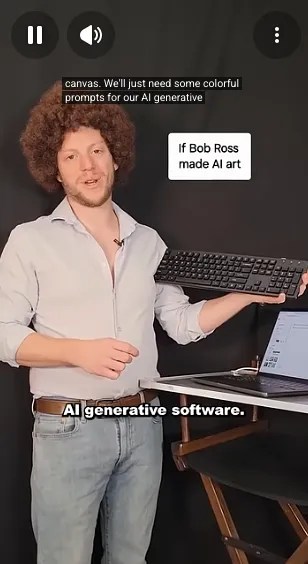
Those equivalents of ‘prompter = writer/artist’ feel enraging. Especially when prompters brandish the argument that the AI is a tool like a paintbrush or a keyboard for writing.
But maybe what we need instead is understanding. Because we’re all still in the learning phase here and I think most prompters genuinely don’t understand what they’re doing.
And I don’t mean holding up a slop product (no matter how pretty) and thinking they’ve made something when they haven’t. I mean they don’t understand what making is, what creating is. And they don’t think what they’re doing is stealing. They don’t understand how the tech was created and what keeps it going. They’re like little babies who have been spoon-fed their whole lives and just expect that ease of goop to filter into satisfying their adult desires.
Hart seemed to have no real self-awareness about admitting to using Anthropic—which is embroiled in 1.5 billion payout to the authors it stole from—to generate her slop.
She thinks she’s ‘thoughtfully creating with’ not ‘sending a command prompt to’. She seems to think she’s working with a machine with thoughts of its own. Like it’s somehow sentient. A thought partner even.
As if, when she sees the little ‘thinking’ icon flashing, it’s actually really, really thinking as opposed to spitting out a mathematical equation in answer to a maths problem that reflects an information bubble of her own making.

People don’t understand the platform and they don’t understand that the more they’re led by the nose by desperate tech bros trying to make them believe they’re somehow ahead of a curve, the more they’re drawn into the very framework that will suck their humanity out of them for someone else’s profit.
They don’t understand that the machine has been humanised by other humans to manipulate them into using it.
They don’t realise their common sense is being leeched out of them.
And I don’t think they realise—or care—that putting out all this trash will eventually overwhelm access to real human creative output.
Because why would they? How could they?
Right now, the average Joe Soap thinks prompting and creating are the same thing. Their value systems are based solely on the final product and they don’t even have the literacy, visual or otherwise, to see the difference. They don’t have the empathetic sensitivity to feel the difference. They don’t have the inclination to problem-solve their way to their own creative endeavour. Much easier to slip into the service that will just spoon-feed you everything.
Hart says in her comment to the backlash: ‘Technology doesn’t remove the need for skill. It raises the bar for it.’ She’s not wrong. It’s just a different skillset to what being a creator requires.
Learning how to maximise the operations of a new piece of tech ≠ learning the skill-set for creating.
You don’t even need to bend over.

When AI companies market to prompters, they’re not marketing to artists. They’re marketing to people who want speed and ease of a product, or people who have an inner landscape of creative longing, but none of the will, skill or grit to bring it to life; people who are deeply ignorant of the context in which they are being used in the short term to make long-term profits for extremely ill men.
It must be kind of devastating if you’re that desperate to create and yet totally incapable of connecting to your own creative spark; when you’re a consumer masquerading as an artist because you think the product you’ve bought (with money, your brain cells or your data) is the art you’ve made.
It’s kind of depressing for them, but there’s an upside to this for us.
I think we’re really in a kind new era of creative understanding—not because the tech’s so good it’s going to create a new landscape of creative thought leaders.
But because it’s presenting us with the opportunity to really engage with what creating is.
It’s the opportunity to start appreciating human endeavour; it’s an opportunity to wrest our divine creative process from Instagram hell where everything must be content, everything must be a product, everything must be sellable, and remind ourselves that the creative process it is actually mostly deeply personal, intensely private. It doesn’t let the world in, it doesn’t require—in fact it shouldn’t get a sniff of—applause and ‘likes’ while it’s in the container of its becoming.
Tom introduced me to a great phrase by James O’Brien: ‘Contempt for the con men, compassion for the conned.’ O’Brien was referring to Brexit. I usually apply this to religion. But I think it’s valuable in this context also.
The AI pushers are doing everything in their power to seduce a global audience with baubles and bubbles, because what AI is good for—research, business, science, understanding data—will never make them as much money as an enslaved billion humans having their egos stroked as they purchase brain rot peddled as convenience.
‘Coral Hart’ might think she’s ahead of the game (or maybe she’s just being paid to say she believes she is), but her and people like her, are turkeys signing up for Christmas. Soon the game they’re helping build will kick them out and then where will they be?
The detox from that is going to be brutal.
t
Remember: The AI takeover is NOT inevitable. The company owners of that product just want you—need you—to believe it is. Let’s not have our humanity taken down by a billion fleas.
Some quick notes before I sign off:
- Pre-orders for The Witch of Benbar’s Cross are open until Feb 28. DM me, leave a comment or email me to order your copy.
- I still have some spots open on JUMP! 2026.
- Just be cool honey bunny.
 TANYA MEESON